
There is a paradox at the heart of many nonprofit organizations: they were founded to change the world, yet they struggle enormously to change themselves.
This is not a criticism. It is one of the most recurrent observations in the third-sector management literature, confirmed by researchers, NGO directors and organizational development consultants. Organizations devoted to transforming society (fighting poverty, defending rights, protecting the environment, supporting vulnerable communities) often find themselves ill-equipped to handle their own internal transformations.
Yet change in nonprofit organizations is not optional: it is a structural necessity. The contexts they operate in are constantly shifting: funding, public policy, community needs, technologies, donor expectations. Organizations that fail to adapt risk irrelevance, regardless of the quality of their mission.
This article explores change management in the nonprofit sector, focusing on the dynamics that make it different from, and in some ways more complex than, managing change in a business. It is aimed at directors, coordinators, program managers and third-sector managers who find themselves leading, or undergoing, processes of organizational transformation.

Why Change in the Nonprofit Sector Is Different
Before applying any change management framework to the nonprofit context, it is necessary to understand why nonprofits have characteristics that make change management structurally different from the private sector.
A volume published by Springer, Change Management in Nonprofit Organizations: Theory and Practice (2019), written by researchers affiliated with the Centre for the Study of Philanthropy & Public Good at the University of St Andrews, systematizes this difference rigorously. Its starting point is that nonprofits must constantly analyze and adapt to the implications of the changing needs of beneficiaries, funders, communities and public policy. But they must do so under constraints that private companies do not face: a mission that acts as an implicit constitution, governance that is often distributed among board, staff and volunteers, and resources that are always insufficient relative to demand.
A scoping study published in Nonprofit and Voluntary Sector Quarterly (Walk et al., 2025), which systematically analyzed the literature on organizational change in the nonprofit sector, shows that transformation processes in NGOs are deeply influenced by variables that weigh less in the for-profit sector: the individual resilience of leadership, the emotional reaction of staff to externally imposed changes (such as the pandemic or funding cuts), and organizational governance.
The practical result is that a manager coming from the private sector who brings their change management frameworks into an NGO often finds them ineffective. This is not because the tools are wrong, but because they are being applied in a context with a different operating logic.
The Starting Point: A Sector Under Pressure
To understand why change management in NGOs is so urgent today, we need to look at the data on the sector.
The 2025 State of the Nonprofit Sector Report by Forvis Mazars, based on data collected from more than 230 sector professionals, paints a worrying picture: almost half of nonprofit organizations lack sufficient resources to deliver their programs and services, and more than three out of four report difficulty recruiting senior leaders. About two-thirds of nonprofits have no leadership mentoring program.
Burnout runs through all the most recent reports. According to the Center for Effective Philanthropy’s State of Nonprofits 2024, 95% of nonprofit leaders are worried about staff burnout, and more than half say they are more worried about their own burnout than the year before. The turnover rate in the nonprofit sector is 19%, compared with 12% in other sectors.
These numbers are not just an HR problem. They are the structural premise within which any organizational change process takes place. An organization whose staff are exhausted, underpaid and uncertain about the future is an organization with a severely reduced capacity for change management, regardless of the quality of the transformation plan.
On top of this comes a specific challenge documented in the 2024 Nonprofit Leader Study (Viva Strategic Communications): 78% of nonprofit leaders cite lack of staff and time as the main obstacle to change, followed by lack of financial resources (72%). Significantly, only 41% point to a lack of leadership as an obstacle: most organizations have a clear direction but are blocked at the execution stage by practical constraints.
The 5 Specific Challenges of Change in the Third Sector
1. Mission as Identity, and as Constraint
In nonprofit organizations, the mission is not a strategic document: it is the collective identity of the organization. This deep identification with founding values is an NGO’s most precious resource, but it can become a formidable obstacle when change is perceived as a threat to that identity.
Resistance to change in nonprofits is often not bureaucratic or opportunistic, as it may be in a private company, but existential. “We are betraying our mission” is one of the hardest objections to handle in a transformation process, precisely because it touches the deep motivations of those who work in the sector.
The nonprofit change manager must therefore be able to distinguish between changes that genuinely challenge the founding values and those that, while modifying processes, structures or operating models, serve those values better. This distinction is not always obvious, and making it explicit through a clear, shared narrative is often the conditio sine qua non of any successful transformation.
2. A Plurality of Stakeholders with Unaligned Interests
A mid-sized company has shareholders, management and employees. An NGO has a board, paid staff, volunteers, beneficiaries, individual donors, funding foundations, institutional partners and reference communities. Each of these groups has legitimate interests, different expectations and a different level of formal and informal power over the organization.
Managing change means managing this relational complexity. A transformation plan that does not consider in advance the position of each stakeholder group (who will support the change, who will obstruct it, who is neutral but influential) is an incomplete plan.
3. Dependence on Volunteer Capital
Nonprofit organizations depend to a variable, but often significant, extent on the contribution of people who are not paid. Volunteers are not bound by an employment contract: if change alienates them, they simply leave. And their departure is not just an operational loss: it is a reputational signal that can spread through the organization’s community.
According to the NOI+ survey promoted by Forum Terzo Settore and Caritas Italiana, 54% of Italian volunteers believe their engagement has a direct impact on the culture and organization of services, and they see themselves as agents of change. Read through a change management lens, this means volunteers do not want to be the object of change: they want to be co-protagonists. Ignoring them in decision-making processes is a strategic mistake, before it is an ethical one.
4. Scarcity of Resources for Transformation
Change management requires resources: management time, specialized skills, communication tools, training budgets. Nonprofit organizations structurally operate under scarcity on all these fronts.
The State of Change Management in the Nonprofit Sector 2025, the first report specifically dedicated to this topic at the international level, documents that among mid-sized organizations (the most common in the European third sector) only about half have a dedicated change management role or team, and that transformation budgets are systematically insufficient. Many organizations find themselves “between ambition and bandwidth”: between the ambition to transform and the concrete capacity to do so.
5. Burnout as a Multiplier of Resistance
Burnout is not just an individual wellbeing problem: it amplifies resistance to change. When people are exhausted, every new initiative is perceived as an additional burden, not an opportunity. Change fatigue, the exhaustion produced by prolonged exposure to transformation processes, often overlaps with structural burnout in the nonprofit sector, creating a condition in which change, even when necessary, meets almost automatic resistance.
Data from the Social Impact Staff Retention Project (2025) show that nearly 7 out of 10 nonprofit employees were actively looking for a new job in 2025. The main reason: too much responsibility with too little support (59%). In this context, a poorly managed change process can be the spark that drives people to leave.
Reference Models Adapted to the Nonprofit Sector
Classic change management frameworks (Kotter, Lewin, ADKAR) were developed primarily for the corporate sector, but they offer valuable tools for nonprofits as well, provided they are adapted.
The Kotter Model in the Nonprofit Sector: What Works and What Needs Adapting
Kotter’s eight steps (create urgency, build a guiding coalition, develop the vision, communicate, remove obstacles, generate quick wins, consolidate, anchor in the culture) are applicable to the nonprofit sector with some substantial modifications.
The guiding coalition phase requires, in the nonprofit sector, the inclusion of representatives of all key stakeholders: not only management, but also influential volunteers, board representatives and, in some cases, beneficiaries. Applied research on nonprofit organizations (East Tennessee State University) confirmed the applicability of the Kotter model to the nonprofit context, with particular emphasis on the initial consensus-building phase.
The vision communication phase must be adapted to the plurality of languages and channels in the nonprofit sector: internal communication to staff is different from that to volunteers, and different again from that to donors and the community. There is no single message that works for everyone.
The anchoring in culture phase is particularly critical in the nonprofit sector and often underestimated. Changes that are not embedded in daily practices, in the stories the organization tells about itself, in recognition criteria and in the onboarding processes for newcomers simply regress.
The ADKAR Model: Focusing on People, One at a Time
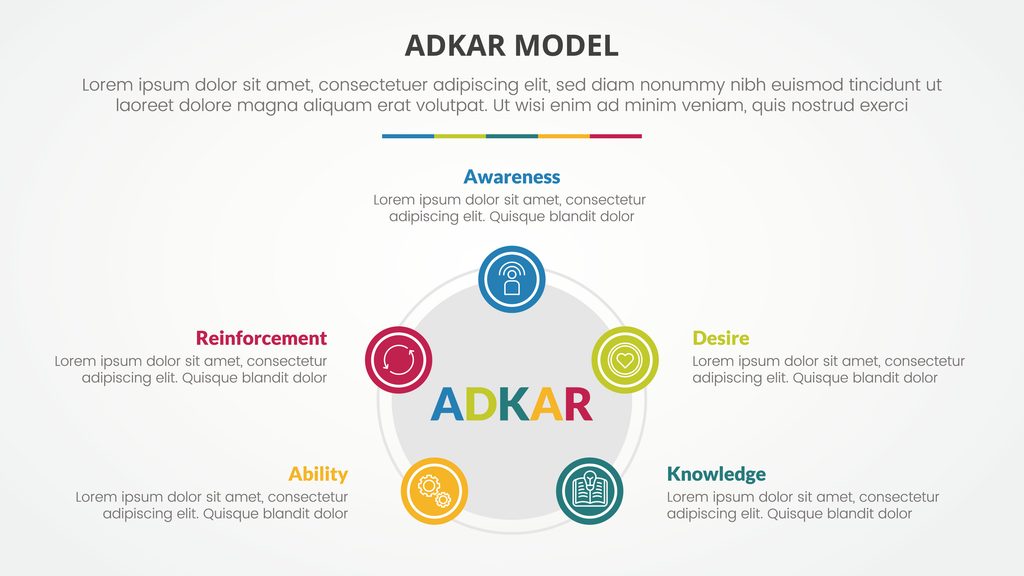
The ADKAR model (Awareness, Desire, Knowledge, Ability, Reinforcement) is particularly well suited to the nonprofit sector because it shifts the focus from the organizational level to the individual level. In organizations where people are motivated by values rather than financial incentives, understanding where change stalls for each individual (lack of awareness? lack of willingness? lack of skills?) allows much more precise and effective interventions.
What Works: Documented Practices
The State of Change Management in the Nonprofit Sector 2025, the first report dedicated specifically to this topic, involving organizations from around the world, offers valuable insights into what distinguishes the nonprofits that manage change successfully from those that fail.
The most effective organizations share some characteristics:
Visible, present leadership. Change in nonprofits works when leaders do not delegate the management of the transformation to a project or task force, but remain present, communicate in person, and are visibly consistent between declared values and concrete behaviors. In small organizations, where change is direct and personal, this is almost automatic. In medium and large organizations, it requires conscious effort.
Processes proportionate to resources. The report’s recommendations stress that effective change in the nonprofit sector must be “practical, pragmatic and proportionate”. It is not about replicating the large transformation programs of multinationals: it is about identifying priority changes, sequencing them realistically, and investing available resources in a targeted way.
Honest communication about difficulty. The organizations that manage change best do not downplay the difficulties of the process: they acknowledge them explicitly. This disarms the resistance that arises from uncertainty and from the perception that leadership is hiding something.
Room for learning. The organizations most resilient in change processes are those that create space for reflection and adjustment along the way, not those that rigidly follow a predetermined plan.
A European Case: The Next Generation You Program
In Italy, a concrete example of how organizational change in the third sector can be managed in a structured way is offered by the Next Generation You program of the Fondazione Compagnia di San Paolo, which involved nonprofit organizations in Piedmont, Liguria and Valle d’Aosta over the four-year period 2021-2024.
In the Foundation’s own words, the program marked “a strategic shift: from the traditional focus on individual projects to a medium- to long-term investment in organizational transformation processes.” The participating organizations were accompanied by organizational development consultants through processes of analysis, strategic planning and change implementation.
The experience showed that the most effective transformations in the Italian third sector start from three conditions: a shared (not top-down) organizational diagnosis, a multi-year development plan that integrates training and process change, and external support that helps the organization build its own capacity, not dependence on consultancy. The model was successful enough to be institutionalized in the 2024 Guidelines for Organizational Development of the Third Sector, with a budget of two million euros.
The Most Frequent Mistakes in NGOs
Announcing change without having built trust. In the nonprofit sector, trust is not optional: it is the main currency of internal relationships. A change process that starts with an announcement, however well communicated, without preliminary listening and engagement work, meets almost automatic resistance.
Treating volunteers and paid staff the same way. Motivational levers are different, expectations are different, the relationship with the organization is different. The same change message can resonate positively with paid staff and alienate volunteers, or vice versa.
Underestimating the time required. In the nonprofit sector, decision-making processes are often slower because they involve more actors. A transformation plan designed with private-sector timelines often gets stuck in governance mechanisms: boards that must approve, members’ assemblies that must be involved, partner networks that must be consulted.
Changing everything at once. With limited resources and staff already under pressure, simultaneously changing multiple organizational dimensions (structure, processes, culture, technology) almost invariably produces paralysis. The most effective organizations sequence their transformations and build momentum through small visible wins before tackling the more complex changes.
Trends 2025-2030: The Change to Come
Digitalization as a driver of forced transformation. According to Momentive (2024) data, the share of nonprofits reporting efficient use of technology rose from 33% to 41% between 2022 and 2023, significant progress but one that still leaves the majority of organizations behind. The digital transition is inevitable, and NGOs that do not manage it as a change management process risk undergoing it in a disorganized way.
The leadership succession crisis. With 76% of organizations struggling to recruit senior leaders (Forvis Mazars, 2025) and interest in top roles declining for years (Building Movement Project, 2022), generational change in leadership is the most delicate and urgent change process the European third sector will face in the coming decade. It requires succession plans, mentoring programs and an organizational culture capable of transferring tacit knowledge between generations of leaders.
Wellbeing as a condition for change. Organizations that manage to build sustainable work environments, with decent pay, realistic workloads and a culture of support, will have a structurally higher capacity for change. Wellbeing is not a luxury: it is an investment in organizational capacity.
Conclusion
Managing change in an NGO is not like managing it in a business. Not because nonprofit people are more resistant or less professional, but because nonprofit organizations operate according to a different logic: the mission is the identity, relationships are the structure, and trust is the currency with which any transformation is paid for.
This makes change management in the third sector more complex, but also richer in meaning. When it works, a change process in an NGO produces not just a more efficient organization: it produces an organization with a renewed capacity to generate impact, to attract motivated talent, and to build lasting relationships with the communities it serves.
The skill of leading change, with method, with respect for people, and with consistency between values and actions, is one of the most valuable a third-sector leader can develop. For those who want to develop it in a structured way, programs such as the LEAD Master at Social Change School integrate change management with strategic planning, leadership and organizational development from a perspective specifically oriented to the European nonprofit sector.
Here is the complete list of sources used in article B1, organized by category.
SOURCES: Change Management Nonprofit
Academic research and scientific reports
- Walk, M., Cart-Turner, L., Peterson, E., Klippel, A. (2025) “Organizational Change in the Nonprofit Context: A Scoping Review of the Literature,” Nonprofit and Voluntary Sector Quarterly, Sage Journals → journals.sagepub.com
- Springer / Centre for the Study of Philanthropy & Public Good, University of St Andrews, Change Management in Nonprofit Organizations: Theory and Practice (2019) → link.springer.com
- East Tennessee State University, Application of Kotter’s 8 Steps for Change in a Nonprofit Organization, honors thesis → dc.etsu.edu
International sector reports
- Forvis Mazars (2025) 2025 State of the Nonprofit Sector Report. Base: 230+ nonprofit professionals → forvismazars.us
- Center for Effective Philanthropy (2024) State of Nonprofits 2024: What Funders Need to Know → cep.org
- Nonprofit Finance Fund (2025) 2025 State of the Nonprofit Sector Survey Findings. Base: 2,200+ organizations → nff.org
- stateofchangemanagement.org (2025) The State of Change Management in the Nonprofit Sector 2025. First international report specifically dedicated to change management in the nonprofit sector → stateofchangemanagement.org
- Viva Strategic Communications (2024) 2024 Nonprofit Leader Study: Exploring Change Management → vivastrategic.com
- Building Movement Project (2022) Survey on interest in nonprofit leadership roles. Figure cited: decline from 50% to 46% (white) and from 40% to 32% (BIPOC) between 2016 and 2022
- Momentive Software (2024) Nonprofit Trends Report 2024. Figure cited: technology efficiency from 33% (2022) to 41% (2023) → momentivesoftware.com
- Social Impact Staff Retention Project (2025). Figure cited: nearly 7 in 10 nonprofit employees were looking for a new job in 2025 → givebutter.com (aggregator of the figure)
Italian and European sources
- Caritas Italiana / Forum Terzo Settore, NOI+ survey on volunteering in Italy. Figure cited: 54% of Italian volunteers perceive their engagement as a factor of cultural and organizational change → caritas.it
- Fondazione Compagnia di San Paolo (2024) Guidelines for Organizational Development of the Third Sector 2024. Budget: €2 million. Program open to organizations in Piedmont, Liguria, Valle d’Aosta → compagniadisanpaolo.it
- Fondazione Compagnia di San Paolo (2026) Organizational Development and the Third Sector: The Next Generation You Experience. Evaluation of the 2021-2024 program → compagniadisanpaolo.it
- Istat / Forum Terzo Settore, data on nonprofit institutions in Italy (2021 update). Context figure: 363,499 active nonprofit institutions, 870,183 employees → forumterzosettore.it
General context sources on change management
- McKinsey & Company (2025) Change is Changing: How to Meet the Challenge of Radical Reinvention. Figure cited: 10 change programs per year per employee, a 5x increase in a decade → mckinsey.com
- Ó Móráin, C. & Aykens, P. (2023) “Employees are losing patience with change initiatives,” Harvard Business Review, May 9, 2023. Primary source of the McKinsey figure on change fatigue
- Gartner (2022). Figure cited: employee willingness to support change fell from 74% (2016) to 43% (2022)