Anyone who works in the nonprofit sector knows that managing a team in an NGO is unlike any other organizational context. Not because people are less professional or less capable — often the opposite is true. But because the motivational levers are different, resources are scarce, the boundaries between roles are fluid, and the risk of burnout is structurally higher than in any other sector.
A program coordinator in an international NGO does not manage just a team of collaborators. In many cases, they manage a complex system that includes paid staff on different types of contracts, volunteers with varied motivations and availability, external consultants, local partners and — in some contexts — beneficiaries who become co-protagonists in the process. All of this with limited budgets, ambitious impact goals and the pressure to justify every expense to funders.
And yet, despite this complexity — or perhaps precisely because of it — the third sector has produced some of the most innovative and humane people-management models of recent decades. This article explores what it means to manage a team in an NGO, what research says about motivation, retention and burnout, and which practices make the difference between a team that falls apart and one that grows.
Why Team Management in the Nonprofit Sector Is a Field of Its Own
Management literature has historically applied frameworks developed for the private sector to the nonprofit world, with often partial results. In recent years, research has begun to recognize that nonprofit organizations have structural characteristics that call for specific approaches.
A bibliometric analysis of volunteer management in nonprofit organizations published in SAGE Open (Xu et al., 2024) mapped the evolution of the literature on the topic, showing that the most recent research focuses on three priority areas: volunteer engagement as a lever of organizational identity, retention mechanisms in high-uncertainty contexts, and the role of communication in building cohesive teams in distributed organizations.
The starting point is a simple but often forgotten observation: volunteers give time; they don’t sell performance. The contractual relationship is absent or weak. Their contribution depends almost entirely on the quality of the experience the organization is able to offer — the meaning they find in their commitment, the recognition they receive, the bonds they build. Managing this relationship requires skills that go well beyond project management.
The Context: A Sector Under Workforce Pressure
Before discussing how to manage a team well, we need to understand the context in which that management takes place.
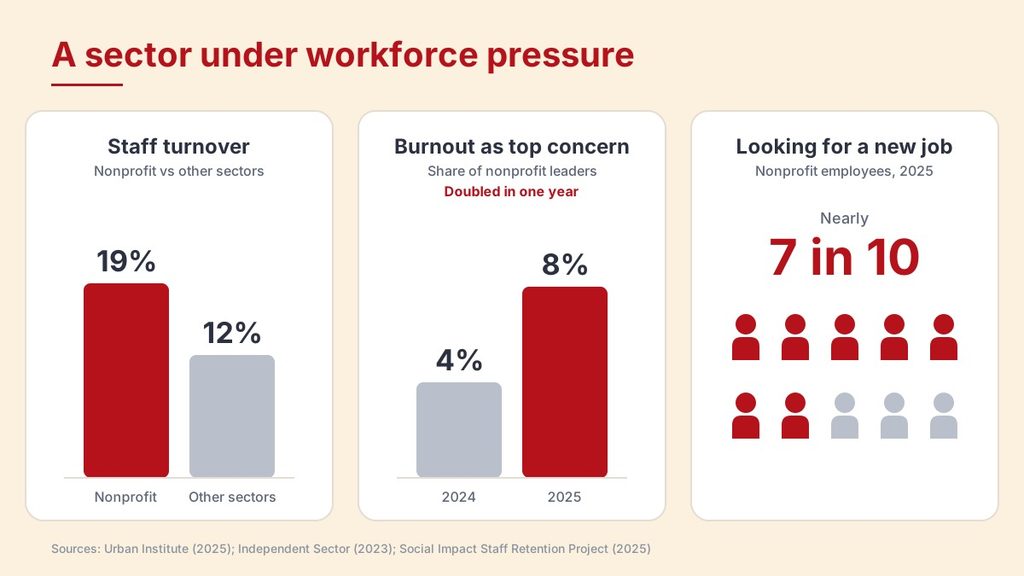
Data from the Urban Institute (2025) — based on 2,975 open-ended responses from nonprofit leaders collected in 2024 — show that roughly 1 in 5 organizations names the workforce as its top concern for the coming year. Among those who cite this concern, 40% focus on staffing and 15% on leadership. Notably, between 2024 and 2025, the share of nonprofit leaders identifying burnout as their top concern doubled, from 4% to 8%.
The turnover rate in the third sector is 19%, compared with 12% in other sectors (Independent Sector, 2023). Every departure has a cost — in recruitment, training and lost tacit knowledge — that resource-constrained organizations struggle to absorb. And in 2025, nearly 7 in 10 nonprofit employees reported that they were looking for a new job (Social Impact Staff Retention Project, 2025).
This picture is not just an HR problem. It is the structural premise within which every coordinator and every director manages their team every day. A team that is constantly turning over cannot build the organizational memory, mutual trust and collective competence that are the necessary conditions for any lasting impact.
The Mixed Team: Paid Staff and Volunteers
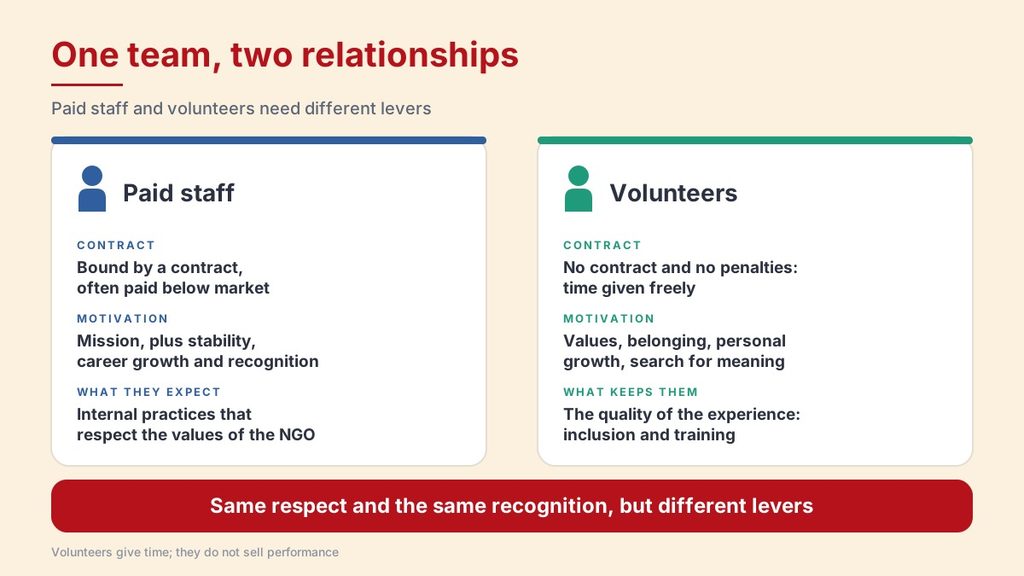
One of the most specific challenges of people management in the nonprofit sector is managing teams made up of people with very different status, motivations and expectations.
On one side, paid staff: professionals who chose the third sector, often accepting salaries below market rates, motivated by the mission but also by the need for economic stability, career development and professional recognition. They are bound by a contract, but they expect — rightly — that the organization will respect its values in its internal management practices as well.
On the other, volunteers: people who give their time freely, driven by deeply varied motivations — ethical values, desire to belong, personal development, skill-building, search for meaning. There are no contractual penalties for those who decide to leave. The only lever is the quality of the experience the organization is able to build.
Research published in the Journal of Public and Nonprofit Affairs (2023) documented that the volunteer management practices that most influence retention are inclusion — the extent to which volunteers feel they are an integral part of the organization — and training — the perception of growing and learning through their commitment. Both are management competencies, not cause-marketing ones.
A second study (Manufacturing & Service Operations Management, 2026) found that the presence of experienced, long-standing volunteers can be a positive retention factor for newcomers — but only if relationships within the team are carefully managed. When groups of experienced volunteers become too closed, they can instead discourage the entry and integration of new members.
Motivation in the Nonprofit Sector: What the Research Says
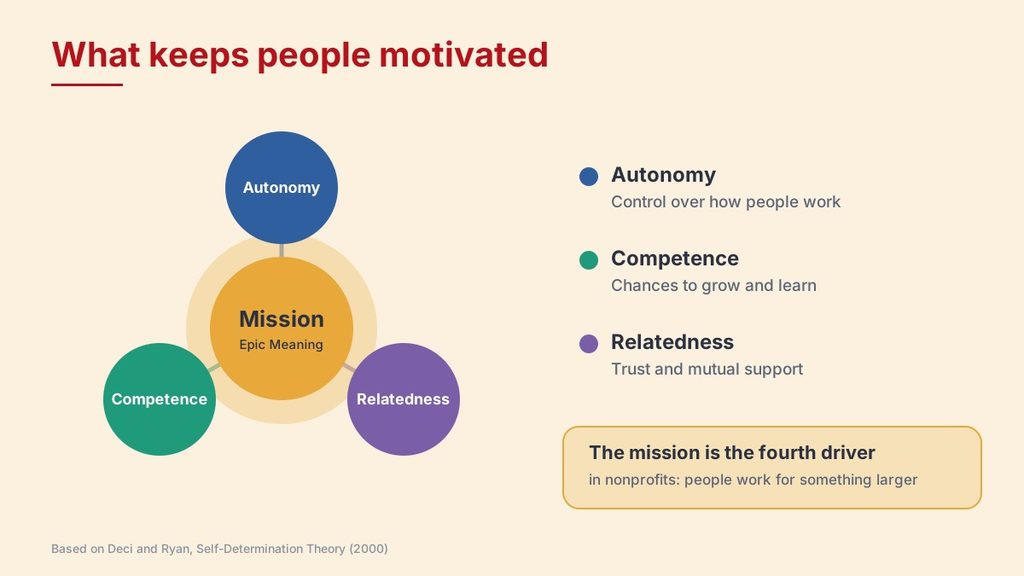
The most solid theoretical framework for understanding motivation in the nonprofit sector is Deci and Ryan’s Self-Determination Theory (SDT, 2000), which identifies three universal fundamental psychological needs: autonomy, competence and relatedness.
When these three needs are met, people develop autonomous, intrinsic motivation — they engage because they want to, not because they have to. When they are frustrated, motivation deteriorates, well-being declines, and organizational behavior becomes defensive or passive.
In the nonprofit sector, this theory has a particularly powerful application for a specific reason: the mission is a fourth level of motivation that does not exist in the same way in the private sector. Volunteers and NGO staff do not work only for autonomy, competence and relatedness — they work for something they feel is larger than themselves. Research on volunteer motivation calls this driver “Epic Meaning” — the need to feel part of something that matters beyond the self.
This motivation is extraordinarily powerful when it is nurtured. But it is also fragile: when the organization proves inconsistent with its own values, when internal bureaucracy stifles initiative, when volunteers don’t see the link between their contribution and real impact, that motivation deflates quickly.
For a coordinator in the third sector, this means that people management is never separate from sense-making: helping people understand why what they do matters, and how their contribution connects to the larger impact, is as important as defining tasks and responsibilities.
The 5 Practices That Make the Difference
1. Define Clear Roles in a Fluid Context
Role fluidity is a hallmark of the nonprofit sector — people covering multiple functions, overlapping boundaries between volunteer and collaborator, flat organizational structures where anyone can do almost anything. This flexibility is an asset in emergencies or in conditions of scarcity. It becomes a problem when it generates persistent ambiguity about who is responsible for what.
McKinsey research has documented that defining clear roles — knowing exactly what contribution is expected from each person — is one of the most robust predictors of success in organizational change processes. The same principle applies to day-to-day team management: role clarity doesn’t limit flexibility; it makes it sustainable.
In the nonprofit sector this requires explicit work: job descriptions for volunteers (not just for staff), structured onboarding, periodic check-ins on expectations and contributions. Not to produce bureaucracy, but to build the trust that comes from knowing what you can expect from others and what others expect from you.
2. Communicate Continuously and in Both Directions
Internal communication is one of the highest-return investments in any organization. In the nonprofit sector, where people are motivated by values rather than financial incentives, communication matters even more: it is the main means by which the organization keeps the shared sense of mission alive.
Research published in Nonprofit and Voluntary Sector Quarterly (Walk et al., 2025) showed that staff and volunteers’ reactions to organizational change are strongly influenced by the quality of the communication they receive. Organizations that communicate transparently — even when the news is not good — build trust that becomes adaptive capital in difficult times.
Two-way communication is equally critical. Volunteers and nonprofit staff often have first-hand knowledge of the needs of the communities served, of operational dysfunctions, of untapped opportunities. Management that doesn’t create channels to collect this information loses a very valuable resource — and, in the process, implicitly communicates that people matter less than hierarchy.
3. Recognize Contributions Specifically
Recognition is one of the best-documented motivational drivers in organizational psychology — and one of the most neglected in daily practice. In the nonprofit sector, where financial compensation is often below market, recognition is not a luxury: it is an integral part of the psychological contract that keeps people in the organization.
The average volunteer retention rate in nonprofit organizations is 45%, but organizations with structured recognition practices reach rates of 75% or higher (VolunteerMatters, 2025). The difference lies not in resources — specific, genuine recognition costs far less than a recruitment campaign — but in attention.
Effective recognition is specific (not “thanks for everything you do” but “thank you for how you handled that difficult situation with the supplier”), timely (close to the event, not in an annual report) and anchored in the mission (showing the link between the individual contribution and collective impact).
4. Actively Manage Team Well-Being
Burnout in the nonprofit sector is not an exception: it is a structural condition that management must actively monitor. 95% of nonprofit leaders express concern about staff burnout (Center for Effective Philanthropy, 2024), and the share of leaders naming it as their top concern doubled between 2024 and 2025 (Urban Institute, 2025).
The causes are systemic: heavy workloads, inadequate pay, continuous exposure to suffering and injustice, the feeling of never having enough resources to do what is needed. A coordinator cannot solve these causes alone. But they can create the conditions in which the team has space to talk about its difficulties, in which early signs of exhaustion are recognized and addressed, and in which well-being is treated as an organizational priority rather than a personal problem.
SDT research offers a practical indication: the conditions that prevent burnout are the same ones that nourish intrinsic motivation. Autonomy — giving people control over how they work wherever possible. Competence — offering opportunities for growth and learning. Relatedness — building a climate of trust and mutual support. When these conditions are met, people are more resilient in the face of structural difficulties that cannot be eliminated.
5. Invest in Feedback and Development
Nonprofit organizations have historically invested little in the professional development of their staff, partly because of budget constraints, partly because of a culture that sees training as a luxury compared with operations. This is a strategic mistake: people who grow professionally are the ones who stay, and those who stay are the ones who build organizational memory and the capacity for impact.
Feedback — regular, specific, growth-oriented — is the most accessible development tool. It requires no budget: it requires time and a willingness to have sometimes difficult conversations. Organizations that build a feedback culture — in which people expect to receive honest input and see it as a sign of care, not criticism — create environments where learning is continuous and improvement is collective.
The Most Common Mistakes in NGO Team Management
Treating volunteers as “free staff.” Volunteers are not zero-cost collaborators: they are people with a different relationship to the organization, different needs and different motivational levers. Managing them with the same tools as paid staff — expecting the same availability, the same performance standards, the same forms of accountability — is a mistake that quickly leads to frustration and attrition.
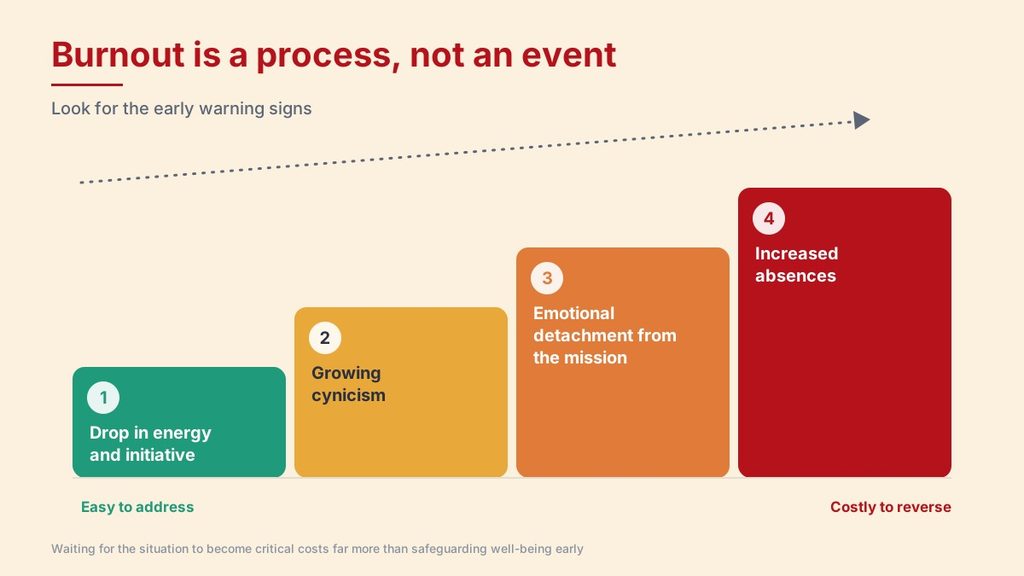
Ignoring burnout signals until it is too late. Burnout is not a sudden event: it is a progressive process with early warning signs that attentive management can recognize — declining energy and initiative, growing cynicism, emotional detachment from the mission, increased absences. Waiting for the situation to become critical before intervening is far more costly than proactively safeguarding well-being.
Under-investing in onboarding. The first period in an organization — whether as staff or volunteer — is when expectations are formed, identification with the mission is built, and the foundations of the relationship with the team are laid. Superficial or absent onboarding has long-term consequences for retention and performance.
Confusing a culture of total commitment with a culture of effectiveness. Many nonprofit organizations implicitly value hours worked as a sign of dedication to the cause. This creates a culture in which those who do the minimum needed to stay well are seen as less motivated, and those who sacrifice themselves to the point of exhaustion are celebrated as heroes. It is a toxic dynamic that produces burnout, turnover and — paradoxically — less impact.
Future Trends: Nonprofit Team Management 2025–2030
Generational renewal as a structural challenge. With 76% of organizations struggling to recruit senior leaders (Forvis Mazars, 2025) and steadily declining interest in top roles, nonprofit organizations face a leadership pipeline crisis that demands urgent investment in mentoring, internal development and succession systems.
Hybrid and distributed management. Corporate volunteering is growing — 77% of companies recorded an increase in employee participation in volunteer programs in 2024. Nonprofit teams increasingly include people who work remotely, with discontinuous availability, through digital channels. Managing this heterogeneity requires tools and approaches different from those designed for co-located, full-time teams.
Well-being as an indicator of organizational performance. More and more organizations are beginning to measure staff well-being as a strategic indicator, not just an HR metric. The logic is simple: an organization where people are well produces more impact, retains more talent and adapts better to changes in its environment.
Conclusion
Managing a team in an NGO is among the most complex and most meaningful forms of management there are. It requires combining the professionalism of management with the sensitivity of working with people deeply motivated by values — and often doing so with insufficient resources, in unstable contexts, knowing that every management error translates not only into an organizational problem but into reduced impact on the mission.
The good news is that research offers increasingly precise indications of what works: role clarity, two-way communication, specific recognition, active attention to well-being, investment in people’s development. These are not magic recipes — they require adaptation to each context, each organizational culture, each team. But they are solid tools, grounded in evidence, and applicable even with the resources typical of the nonprofit sector.
For those who want to develop these skills in a structured way — integrating them with leadership, strategic planning and organizational development in the specific context of the third sector — programs such as Social Change School’s Master LEAD offer a specialized reference point for nonprofit executives and managers in Europe.
SOURCES USED
- Xu, J. et al. (2024). “Volunteer Management in Nonprofit Organizations: A Bibliometric Analysis.” SAGE Open. [journals.sagepub.com]
- Walk, M. et al. (2025). “Organizational Change in the Nonprofit Context: A Scoping Review of the Literature.” Nonprofit and Voluntary Sector Quarterly. [journals.sagepub.com]
- Deci, E.L. & Ryan, R.M. (2000). “Self-Determination Theory and the Facilitation of Intrinsic Motivation, Social Development, and Well-Being.” American Psychologist, 55(1), 68–78.
- Independent Sector (2023). Value of Volunteer Time. Data cited in: Journal of Public and Nonprofit Affairs (2023).
- Journal of Public and Nonprofit Affairs (2023). “The Influence of Volunteer Management on Retention and Promotion of the Organization.” Vol. 9(3), 278–296.
- Tipnis, V.S., Chen, C.J., Gao, F. (2026). “Enhancing Volunteer Retention: The Role of Experienced Volunteers.” Manufacturing & Service Operations Management. [pubsonline.informs.org]
- Traeger, M. et al. (2023). Organizational identity in NGOs and volunteer outcomes. Cited in: Xu et al. (2024).
- Urban Institute (2025). “Nonprofit Leaders’ Concerns About Finances, Programming, and Workforce Challenges Intensified from 2024 to 2025.” [urban.org]
- Urban Institute (2025). “Nonprofit Leaders’ Top Concerns Entering 2025.” [urban.org]
- Center for Effective Philanthropy (2024). State of Nonprofits 2024: What Funders Need to Know. [cep.org]
- Forvis Mazars (2025). 2025 State of the Nonprofit Sector Report. [forvismazars.us]
- Social Impact Staff Retention Project (2025). Survey on intention to leave nonprofit jobs.
- VolunteerMatters (2025). “Volunteer Retention Strategies That Work in 2025.” Cited figure: average retention 45%, top performers 75%+. [volunteermatters.com]
- Nonprofit Learning Lab (2025). “Volunteer Engagement in 2025: What the Latest Data Means for Your Program.” Cited figure: 77% of companies reported an increase in corporate volunteering in 2024. [nonprofitlearninglab.org]
- McKinsey & Company. “The Science Behind Successful Organizational Transformations.” Cited figure: role clarity increases the likelihood of success by 3.8x. [mckinsey.com]