

VISION E MISSION
- Improving HRM quality. Support the improvement of the quality of HR departments’ work. Through a conceptual paradigm shift, a talent intelligence strategy, and high-level digital and AI-driven operations;
- Improving the quality of people. Identify, attract, recruit and retain new talent and future leaders. Develop predictive analyses of professional success through longitudinal studies;
- Reducing costs per selected candidate. At the same time, achieve a reduction in costs per candidate (economies of scale, outsourcing of functions) while improving process quality.
- Organisations without an HR Department that need to outsource the entire recruitment process.
- Organisations with a semi-structured HR Department requiring extensive support.
- Highly structured organisations wishing to innovate processes, reduce costs, improve quality and redefine their strategies.
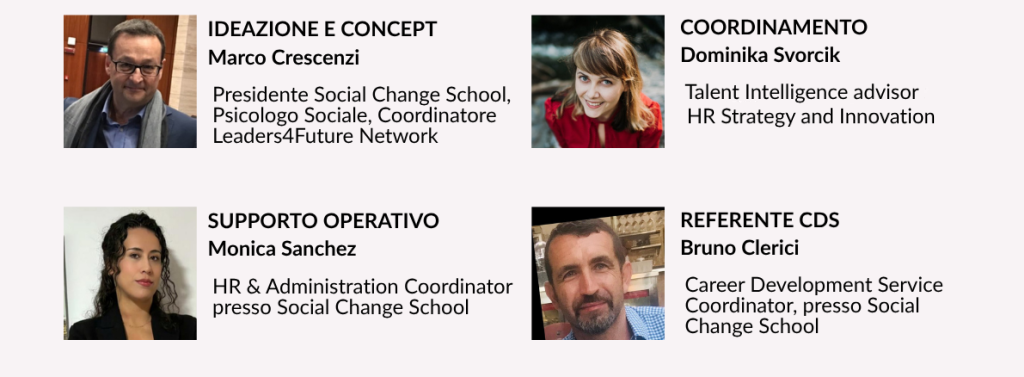
If you are an organisation interested in learning more about the service, please contact Dominika Svorcik: dominika.svorcik@socialchangeschool.org
Key Concepts
- Talent Intelligence. “Talent is everywhere. Talent Intelligence helps you find it, understand it and unlock its potential” (Talent Mapping, internal talent marketplace). See below for a scientific definition.
- Talent-generating ecosystem (through integrated local and thematic partnerships)
- “Candidate Persona” vs Job Description (today’s recruitment processes often fail to capture a person’s story and complexity, focusing instead on a list of tasks and previous roles).
- Right People (“It is not the people who make the difference, it is the right people.”)
- Candidate Experience (careful management of every touchpoint, not only during recruitment)
- Proactive Hiring vs Reactive Hiring
- AI-empowered (the use of AI throughout every stage of the various processes)
- HRM as the key role and the most decisive figure after the General Director for the success of the organisation.
BENEFITS AND EXPECTED RESULTS
- Time savings (minimisation of repetitive processes, process automation, logical interconnection, identification of bottlenecks)
- Cost savings/economies of scale (shared HR office across multiple organisations, reduced HR staff costs, automation of part of the interviews and performance evaluation processes)
- Upgrading HR work: greater purpose, increased attractiveness, value creation, reduced stress
- Communication: integrated, consistent, streamlined, traceable, ready-to-use and personalised, with standardised processes (including for newly onboarded HR staff)
- Better understanding of the market: benchmarking (using AI agents/specialised platforms to understand competitors’ strategies), sector turnover analysis, and talent intelligence in general
- HR outsourcing: for organisations that do not have, or do not wish to invest in, an HR department while aiming for a high standard of candidate selection and process management
- Benchmarking/comparison among the best digital tools
- Better alignment with Gen Z: improved candidate experience and reduced turnover
- The best international predictive assessment tools for professional success, resilience under stress, leadership potential and teamwork capabilities
- ATS systems – Applicant Tracking System
- Automated CV analysis and matching
- Automated competitive benchmarking
- AI video interviews and automated ranking with the generation of shortlists
WHERE WE CAN SUPPORT YOU
- Recruitment
- Onboarding
- Talent Management
- Offboarding
TALENT INTELLIGENCE
What It Is and Why It Is Strategic for the Future of Human Resources
Talent Intelligence is the systematic process of collecting, integrating, analysing and using internal and external data related to talent, aimed at supporting strategic human resources decisions, with the objective of attracting, developing, retaining and enhancing the people best suited to the organisation’s current and future needs.
It combines internal data sources (performance, skills, career paths, engagement) with external data sources (market trends, salary benchmarks, demographic data, competitors, labour market dynamics) through the use of advanced technologies such as artificial intelligence, machine learning and people analytics tools.
Key Elements
- Data-driven HR: HR decisions based on objective and predictive insights.
- External & Internal Data Fusion: combines organisational data with labour market data.
- Strategic Workforce Planning: enables proactive planning of future skills needs.
- Competitive Intelligence: helps map employer brand positioning and attract the most sought-after talent.
- AI & Predictive Analytics: predictive models for turnover, promotions, internal mobility, etc.
What It Is Used For
- Planning critical roles and skills in advance
- Improving employer branding and talent acquisition
- Reducing turnover and optimising human capital
- Making HR truly data-driven and proactive